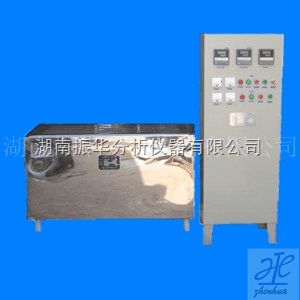
Glass Crystallization Test Furnace
The Glass Crystallization Test Furnace determines the crystallization properties of glass by using the gradient furnace method. It is widely applicable in factories, schools, and research institutions for analyzing non-metallic materials such as glass and gemstones.
- Model
- GXT
- Category
- Glass Testing
- Published
- August 12, 2016
Product Description
The GXT Glass Crystallization Test Furnace uses the gradient furnace method to measure the crystallization properties of glass, offering a temperature gradient range between 1000°C and 1600°C. This method is crucial for understanding and controlling the production process and forming techniques of non-metallic materials such as glass, which often tend to crystallize under certain conditions.
Crystallization, also known as devitrification or reverse vitrification, refers to the tendency of glass, with higher internal energy compared to its crystalline counterpart, to spontaneously form crystals under certain conditions. By determining the range of crystallization temperatures, as well as the degree of crystallization within that range, this equipment assists in developing optimal melting, forming, and thermal processing strategies to produce transparent and desirable glass products. Its applications span factories, schools, and research institutions focusing on the analysis and testing of glass materials.
Technical Specifications
| Parameter | Specification |
|---|---|
| Maximum Temperature | 1650°C |
| Common Operating Temperatures | 1000°C, 1300°C, 1400°C, 1600°C |
| Furnace Chamber Size | Φ60/Φ50mm, length 1000mm, heating zone length 400mm |
| Furnace Chamber Material | 99.99% alumina (resistance up to 1700°C) |
| Insulation Layer Thickness | Not less than 100mm for both the cylindrical and end surface layers |
| Insulation Material | Mullite fiber, resistance up to 1600°C |
| Heating Rate | 0-15°C/min adjustable |
| Furnace Power | 6KW/8KW |
| Feeding Method | Manual feeding from the low-temperature end |
| Observation Port Diameter | Φ60mm |
| Temperature Gradient | 1000-1600°C |
Contact Us for Pricing
Interested in this product? Reach out for a personalized quote or more information. Our team will respond within 24 hours.